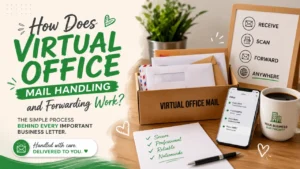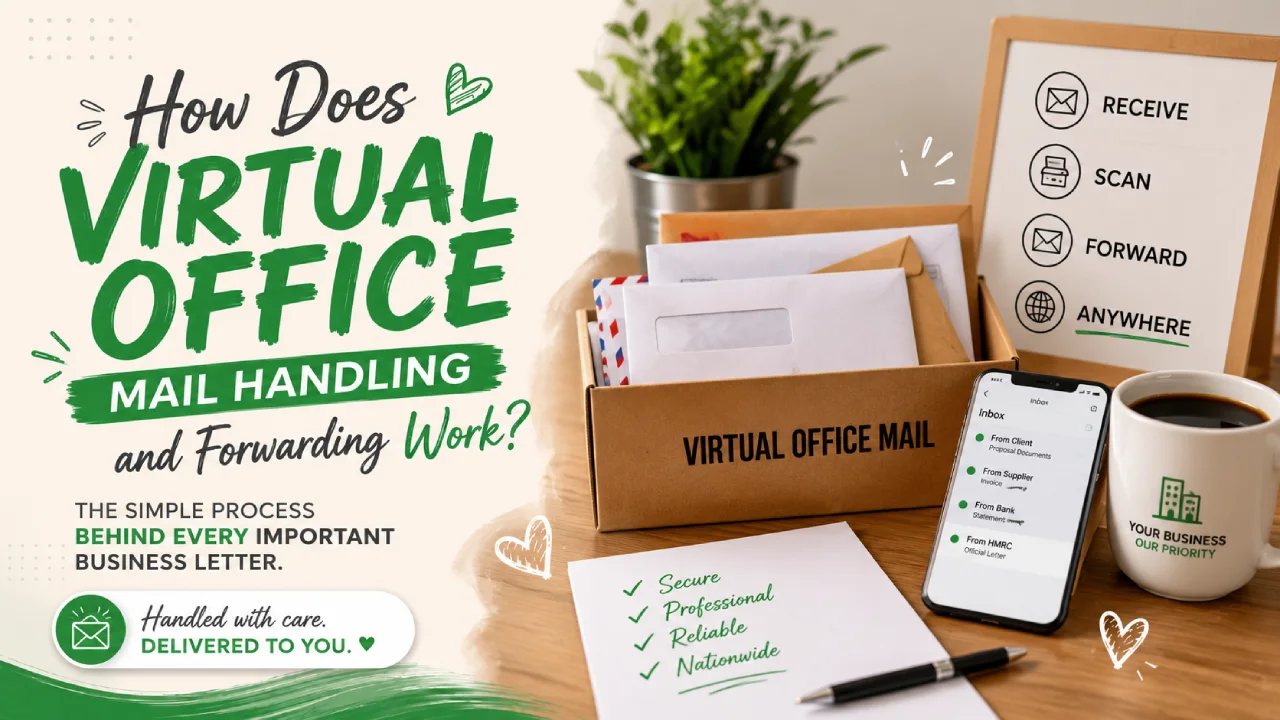
A virtual office mail handling service gives your business an address where post can be received without you renting a permanent physical office. When correspondence arrives, the provider receives it on your behalf and, depending on your package, holds it securely for collection or forwards it to an address you have nominated.
Some providers also offer notifications, parcel handling or digital scanning. These services vary, so it is worth understanding exactly what happens to your post before choosing a virtual office.
For business owners working from home, travelling regularly or running a remote company, that can make dealing with physical correspondence much simpler while keeping a professional business address separate from where they live.
What Is Virtual Office Mail Handling?
Virtual office mail handling is the process of receiving and managing business correspondence sent to your virtual office address.
Instead of a supplier, client or government department sending a letter to your home, they send it to the professional address you use for your business.
The virtual-office provider receives the item and deals with it according to the service you have agreed.
That could mean holding it until you visit, forwarding it somewhere else or using another mail-management option where available.
Mail handling is therefore the overall service. Mail forwarding is one way in which the received post can subsequently reach you.
How Does Virtual Office Mail Handling Work Step by Step?
The exact process varies between providers, but a typical service works something like this.
1. You Start Using the Business Address
Once your virtual-office service has been activated, you can use the permitted business address for relevant correspondence.
Depending on the package and provider, that could include letters from clients, suppliers, banks and other organisations.
Some services can also provide an address suitable for company registration, although you should always confirm what your specific package allows before publishing the address.
2. Your Post Arrives at the Office
Letters and permitted deliveries are sent to the virtual-office address just as they would be sent to a conventional workplace.
The main difference is that you do not need to be sitting inside the building waiting for them.
Instead, the on-site team receives the post on your behalf.
Where parcel acceptance or signed-for deliveries form part of the service, reception may also be able to receive those items. Providers can set restrictions around dimensions, weight, storage time and courier deliveries, so check these before ordering anything substantial.
3. The Mail Is Identified and Handled
After a letter arrives, it needs to be matched to the correct business or individual using the address.
A mail-handling provider may then sort and securely store it until the agreed next step.
This sounds straightforward, but it is an important part of the service. A single business address can be used by several companies, so having clear records and correct recipient details helps ensure correspondence reaches the right person.
When registering, make sure the provider knows every authorised business or recipient name under which you expect to receive post.
4. You May Be Notified
Some virtual offices notify clients when post arrives.
This could be by:
- telephone
- an online account
- another agreed notification method
Other packages may simply forward items automatically according to a schedule.
There is no universal approach, which is why notification arrangements should be checked before signing up.
For somebody who receives only occasional statutory correspondence, an arrival notification can prevent unnecessary trips to the office. Businesses receiving post regularly may prefer scheduled forwarding instead.
5. You Choose What Happens Next
Once mail has been received, what happens depends on your agreement.
The most common options are collection, holding and forwarding.
Where the provider offers digital mail services, scanning may also be available.
That flexibility is one of the main reasons virtual office mail handling works well for businesses without a conventional office.
What Is Mail Forwarding?
Virtual office mail forwarding means physical correspondence arriving at your business address is subsequently sent to another postal address.
For example, you might use a Bournemouth business address publicly but work primarily from home.
A letter arrives in Bournemouth, the virtual-office team receives it, and it is later forwarded to the address you have nominated.
The destination does not necessarily need to be your home. Depending on the provider’s terms, businesses that travel or work from several locations may be able to nominate another suitable forwarding address.
How Often Can Mail Be Forwarded?
There is no industry-wide forwarding schedule.
Some services offer forwarding:
- as soon as requested
- daily
- weekly
- at another agreed interval
Bournemouth Office Services, for example, currently describes daily, weekly and monthly forwarding options, illustrating how providers can structure the service differently.
Frequent forwarding can make sense when the business receives time-sensitive correspondence. Less frequent forwarding may suit a company receiving only occasional physical post.
Always check how forwarding frequency affects cost.
Mail Holding vs Mail Forwarding
Mail does not always need to be forwarded.
With mail holding, the provider keeps the correspondence securely at the office until you collect it.
That can work well when you live or work near Bournemouth and visit regularly.
Mail forwarding is more useful when getting to the office is inconvenient.
| Service | What Happens to Your Mail? |
|---|---|
| Mail holding | Post remains at the office until collection |
| Mail forwarding | Post is sent onwards to a nominated address |
| Mail scanning | Contents may be digitised where the provider offers this service |
| Automatic forwarding | Received mail is sent onwards on an agreed schedule |
A business can sometimes combine collection and forwarding rather than choosing only one.
For example, important correspondence could be forwarded while less urgent items remain available for collection.
Does a Virtual Office Open Your Mail?
Not necessarily.
Receiving an envelope and opening its contents are two separate things.
A traditional forwarding service normally only needs to receive and resend the item. A mail-scanning service may require the provider to open authorised correspondence so that its contents can be digitised.
You should never assume that a virtual-office company will open or scan your post.
Check:
- whether scanning is available
- what permission is required
- what categories of mail can be opened
- how scans are delivered
- whether scanning attracts a separate charge
- how original documents are stored afterwards
This is especially important where correspondence contains confidential financial, legal or personal information.
Can a Virtual Office Receive Parcels and Signed-For Deliveries?
Some can, but not every package includes this.
A virtual office may be able to receive:
- ordinary letters
- large letters
- small packets
- parcels
- courier deliveries
- signed-for items
For example, Mail Boxes Etc. Bournemouth specifically advertises parcel acceptance and signed-for delivery handling alongside its virtual mailbox services.
That does not mean every Bournemouth provider offers identical facilities.
Before using your virtual-office address for deliveries, find out whether there are limits on size, weight, storage periods or particular couriers.
Receiving occasional documents is very different from using an office reception as an ecommerce warehouse.
Does Mail Forwarding Cost Extra?
Often, yes.
A virtual-office subscription may cover the address and receipt of mail but charge separately when items need to be forwarded.
Possible charges include:
- handling
- envelopes or packaging
- Royal Mail postage
- recorded or special delivery
- courier charges
- overseas postage
- parcel storage
- mail scanning
The pricing structure matters as much as the headline monthly fee.
A cheaper virtual office can become more expensive if every letter creates several additional charges.
Before signing up, ask for an example based on your actual situation:
“If I receive five letters each month and want them forwarded once a week, what would I pay in total?”
That gives you a much more useful comparison than the subscription price alone.
Can Companies House Post Be Sent to a Virtual Office?
A virtual-office address may be suitable as a registered office when both the provider and address meet the relevant requirements.
Companies House currently requires a registered office to be a physical UK address within the appropriate UK jurisdiction. It must also be an appropriate address, meaning documents delivered there should be expected to come to the attention of someone acting for the company and delivery must be capable of acknowledgement.
A Royal Mail PO Box cannot be used as the registered office.
However, Companies House confirms that a company can use a service provider’s address when permission has been given and the address meets the requirements.
That makes reliable mail handling particularly important.
A registered office should not simply make a business look established. Important statutory correspondence sent there must actually reach the company.
Companies House has previously advised businesses using a third-party mail-handling provider to make sure the service includes sending company correspondence on to them.
Why Does a Virtual Office Provider Ask for ID?
Do not be surprised if a legitimate provider asks you to complete identification or customer checks before activating the address.
Virtual-office businesses providing registered office, business address, correspondence-address or administrative-address services can fall within regulated trust or company service-provider activity under UK money-laundering rules. HMRC’s current supervision guidance specifically discusses these services.
The exact checks depend on the provider, service and customer.
For a business owner, the practical point is simple: an identity-verification process is not unusual when obtaining this type of business-address service.
How Secure Is Virtual Office Mail Handling?
The service involves correspondence that could contain business or personal information, so security deserves more attention than a promise that your post will be “handled professionally”.
Before choosing a provider, ask:
- Who has access to incoming mail?
- Where is uncollected mail stored?
- How is mail matched with recipients?
- How long will items be held?
- How are sensitive items forwarded?
- What happens to uncollected post?
- Can someone else collect on your behalf?
- How are recipient and forwarding-address changes verified?
A professional Bournemouth address is useful, but the handling process behind that address matters just as much.
Who Benefits Most From Mail Forwarding?
Virtual office mail handling can suit several types of business.
Home-Based Business Owners
Using a professional business address can separate correspondence from home life.
It can also prevent a home address from becoming the default destination for every supplier, enquiry and business document.
Remote Companies
A distributed team may not have one permanent office where somebody is available to receive deliveries.
A virtual office gives the company a consistent point for business correspondence.
Freelancers and Consultants
Independent professionals may want a business address without needing a desk five days a week.
Mail can arrive at one established location while the person works flexibly elsewhere.
Businesses Entering Bournemouth
A company establishing a presence in Bournemouth may initially need an address and occasional meeting facilities before it needs permanent office space.
A virtual office can provide that starting point while the company’s local requirements develop.
What Should You Ask Before Choosing a Mail Handling Service?
Do not compare providers using the monthly price alone.
Ask these questions first:
- Which types of mail do you accept?
- Are parcels and courier deliveries included?
- Will you notify me when post arrives?
- Can I collect it?
- How often can post be forwarded?
- What are the handling and postage charges?
- Is scanning available?
- How long will you store mail?
- Can I use the address as my registered office?
- What happens if an item arrives under a name you do not recognise?
The answers will tell you much more about the service than whether an address looks impressive on Google Maps.
Virtual Office Mail Handling in Bournemouth
For a Bournemouth business, the best arrangement depends on how you actually work.
A founder working from home near the town centre may prefer collecting post when convenient. Someone travelling across the UK may need regular forwarding. A remote business may receive so little physical mail that notification and occasional forwarding are enough.
Green Park Arlington provides businesses with a professional Bournemouth base alongside flexible workspace services. When considering a virtual-office package, the Green Park team can explain the current mail-handling arrangements, what address uses are permitted and which additional charges or options apply.
The important point is to choose the service around the way your business receives correspondence rather than simply choosing an address.
A Virtual Office Should Do More Than Provide an Address
A good virtual office does not simply put a Bournemouth address on your website.
It gives your business a reliable way to receive important correspondence when you do not have someone sitting in a permanent office every day.
Before choosing a service, understand exactly how post is received, stored, collected or forwarded, what happens to parcels, and what additional charges apply.
Once that process is clear, virtual office mail handling can be a straightforward way to keep business correspondence organised while maintaining the flexibility to work from wherever makes sense for you.
Frequently Asked Questions
What Happens to Mail Sent to a Virtual Office?
It is delivered to the virtual-office address and received on your behalf. Depending on the service, it can then be held for collection, forwarded or handled using another agreed option.
Can a Virtual Office Forward My Post?
Yes, many virtual-office providers offer mail forwarding. Frequency, destination restrictions and charges vary, so check the provider’s terms.
Can I Collect My Mail Instead of Having It Forwarded?
Many services allow collection during specified hours. Some may also offer more flexible mailbox access.
Does a Virtual Office Open My Letters?
A standard mail-forwarding service does not necessarily require letters to be opened. Opening is more relevant to mail-scanning services and should only happen according to the agreed service and authorisation.
Can a Virtual Office Receive Parcels?
Some can receive packages and courier deliveries, but size, storage and delivery restrictions vary.
Can HMRC and Companies House Mail Be Sent There?
When the virtual-office address is legitimately being used as your registered office or relevant correspondence address, official mail can be sent there. Confirm that your chosen service is suitable for that use.
How Quickly Will Mail Be Forwarded?
It depends on the provider and package. Forwarding may take place on request, daily, weekly or according to another agreed schedule.
Is Mail Forwarding Included in the Virtual Office Fee?
Not always. Some packages include a level of mail handling while forwarding postage, packaging or handling charges are billed separately.